The first time you watch a padel match, the scoring can look a little baffling. Points called in fifteens, games that end on a single sudden-death rally, sets that go to tiebreaks. It is a lot to take in at once. But here is the thing: padel scoring explained properly takes about five minutes to understand. Once you see the pattern, it all clicks. The system is borrowed from tennis, so if you have played that before, you already know more than you think. And if you have not, no worries at all. This guide will walk you through everything, from how a single point is won right through to how a full match is decided.
If you are still getting your head around the sport more broadly, it is worth reading our Padel Rules for Beginners guide alongside this one. And if you are wondering how padel compares to the sport it grew out of, our Padel vs Tennis breakdown covers that well.
How a Point Is Won
Before getting into the numbers, it helps to know how points actually end. A team wins a point when the ball bounces twice on the opponent’s side, when it goes out of bounds, or when the opponents hit it into the net. The glass and metal walls are in play, which is the part that makes padel unique. A ball can bounce off the back or side wall and still be returned legally, as long as it has already bounced once on the court surface first. If a ball hits the wire fencing without bouncing on the court first, it is out.
That is the basics. Once you understand what finishes a point, the scoring system is straightforward to layer on top.
How Game Scoring Works
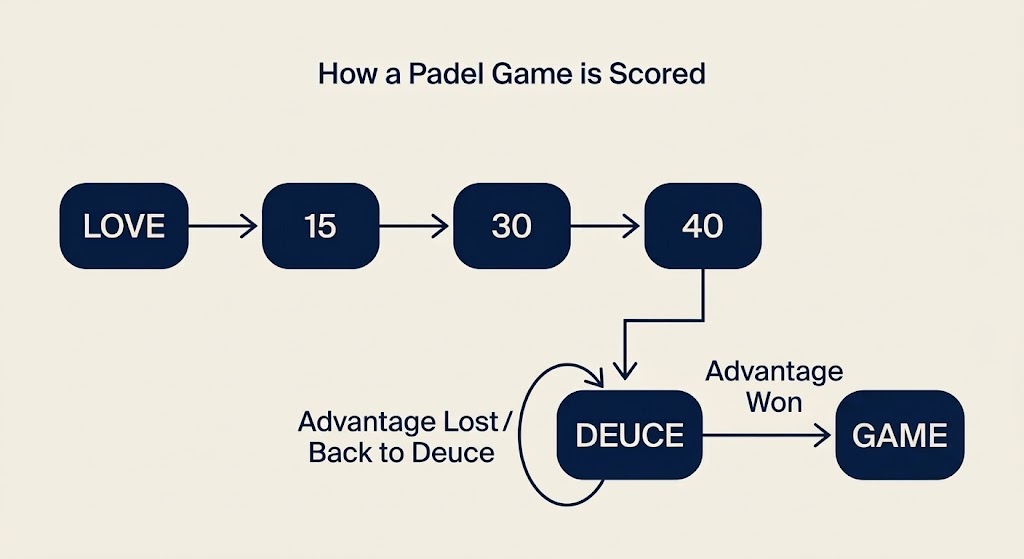
Padel uses the same points system as tennis: 15, 30, 40, and game. When a rally starts, both teams are at zero, which is called “love.” The first point takes you to 15, the second to 30, the third to 40, and winning one more closes out the game. Each game in a padel match is scored this way.
When both teams reach 40, the score is called “deuce.” This is where things get slightly more interesting, and where padel has started to do things a little differently from tennis. More on that shortly.
The server’s score is always called first. So if the serving team has won two points and the receiving team has won one, the score is 30-15.
The Golden Point Rule
For a long time, padel handled deuce the same way as tennis: one team had to win two consecutive points to take the game. The first of those points gives them “advantage,” and if they win the next one, the game is theirs. Lose it, and it goes back to deuce, potentially cycling like that for a while.
The Golden Point changed that. Under Golden Point, when a game reaches deuce, a single point decides it. No advantage. No back and forth. One rally, and the game is over. The team that wins that rally wins the game.
The Golden Point also gives the receiving team a say in how it plays out. Before the serve, the returning players choose which side of the court the server must serve to. That small tactical decision adds a meaningful layer of strategy to what would otherwise be a coin flip under pressure.
The Golden Point was used extensively on the World Padel Tour circuit and brought a lot of drama to professional matches. It speeds the game up and creates intense, high-stakes moments. Some players love it. Others feel it removes some of the comeback possibilities that make long deuce battles so compelling to watch. That debate is part of why the rules continued to evolve.
The Star Point Rule
Starting from the 2026 season, the International Padel Federation introduced a new format for official professional competitions called the Star Point. It sits between classic advantage and the Golden Point, trying to take the best elements of both.
Here is how it works. When a game reaches deuce, the first two advantages play out the traditional way. If the team with advantage wins the following point, they win the game. If they lose it, the score goes back to deuce. That can happen twice. After the second time the advantage is lost and the score returns to deuce for a third time, a Star Point is played. This single decisive point closes the game, no matter who wins it. Like the Golden Point, the returning team gets to choose which side of the court the serve goes to.
The logic is straightforward. Classic advantage lets games drag on indefinitely, which is exhausting for players and hard to schedule for broadcasters. Pure Golden Point can feel a bit harsh, ending a game on one rally before either team has really had a chance to fight for it. The Star Point lets both teams have a genuine tilt at the advantage situation, but puts a clear cap on how long it can go.
The Star Point was approved unanimously by the FIP General Assembly in November 2025 and debuted at the FIP Bronze Melbourne in January 2026. It now applies across Premier Padel, the CUPRA FIP Tour, FIP Promises, and the amateur FIP Beyond circuit.
Set and Match Scoring
Games add up into sets, and sets add up into a match. The first team to win six games takes the set, but they need to be ahead by at least two. So if it is 5-5, play continues until someone is two clear. A team winning 7-5 takes the set.
If the set reaches 6-6, a tiebreak decides it. A tiebreak is played to seven points, and again the winning team needs to be at least two points clear. So it could end 7-5 or stretch further if teams keep trading points. The serving rotation in a tiebreak follows its own pattern, but the basics are the same: first to seven, win by two.
A full padel match is typically best of three sets. Win two sets, win the match. At the professional level, all three sets can be played to their full conclusion. At recreational and club level, something called a Super Tiebreak is often used instead of a full third set, particularly when time is limited. A Super Tiebreak is played to ten points rather than seven, still with a two-point margin needed to win. It is faster, and it keeps the competitive tension of a proper decider without adding another forty-five minutes to the match.
How Recreational Players in the US Typically Play
If you are heading to a padel club in the US for a casual session or a club social, you may not encounter the Star Point at all. That is a rule for professional and official competitive play.
What many US clubs and recreational players use instead is a hybrid approach to deuce. Rather than playing Golden Point from the very first deuce, they play traditional advantage for the first two deuces. If the game reaches deuce a third time, that third deuce becomes a Golden Point: one point, game over. It is a sensible middle ground that keeps things moving without feeling too sudden.
For the third set, most recreational groups skip the full set entirely and go straight to a Super Tiebreak. First to ten, win by two. It is quick, it is decisive, and it almost always produces a clean result within a reasonable timeframe.
None of this is standardised across every club, so it is always worth asking before you start. If you are looking for courts near you to try this out, our How to Find a Padel Court Near You guide is a good place to start.
Quick Tips for Keeping Score During Your First Match
Calling the score in padel can feel awkward when you are new. A few habits will make it much easier.
Always call both scores before you serve, server’s score first. It keeps everyone on the same page and avoids the familiar “wait, what’s the score?” conversation that tends to derail casual games.
Agree on your deuce format before you start. Golden Point from the first deuce? Two deuces then Golden Point? Classic advantage? Five minutes of agreement at the start saves a lot of confusion later.
If you lose track, just ask. Nobody minds. It is far better to confirm than to play a game under the wrong score for three rallies.
Use a simple tracking method if needed. Some players tap the score with their fingers between points. Others call it loudly after every rally. Whatever works for your group is the right approach.
Wrapping Up
Padel scoring is genuinely not complicated once it settles in. The 15-30-40 structure is exactly what you know from tennis. Games build into sets, sets build into matches, and the deuce rules are the only part that vary depending on where and how you are playing. The Star Point is the newest piece of the puzzle, added to make competitive padel easier to follow and fairer on players. At recreational level, the golden point variation keeps things simple and fun.
Go play a few games, call the score out loud as you go, and it will feel completely natural within a session or two.
Frequently Asked Questions
What is the golden point in padel?
The golden point is a rule used at deuce where a single point decides the game instead of playing advantage. The returning team chooses which side of the court the server must serve to, adding a tactical element to the decisive rally. It has been widely used in professional padel and is common at recreational club level.
How does scoring work in padel?
Padel uses the same points system as tennis: 15, 30, 40, and game. The first team to reach 40 and win one more point takes the game, unless both teams are at 40 (deuce), at which point a tiebreaker format applies. Sets go to six games (win by two), with a tiebreak at 6-6. Matches are typically best of three sets.
What is a star point in padel?
The Star Point is a new scoring rule introduced by the International Padel Federation for the 2026 season. When a game reaches deuce, the first two advantages are played the traditional way. If the game goes to a third deuce, a single decisive point called the Star Point is played. The returning team chooses which side of the court the server must serve to, and whoever wins that point wins the game.
How many sets in a padel match?
A standard padel match is best of three sets. The first team to win two sets wins the match. At recreational level, the third set is often replaced by a Super Tiebreak played to ten points (win by two), which saves time while still producing a definitive result.
What happens at deuce in padel?
At deuce (40-40), the format depends on the competition or club rules being used. In traditional play, one team must win two consecutive points to take the game, with the first of those called advantage. Under the Golden Point format, a single point decides the game immediately at deuce. Under the new Star Point system used in professional competition from 2026, advantage plays out normally for the first two deuces, and a decisive single point is played if the game reaches a third deuce.
Disclosure: PadelGuide is reader-supported. Some links on this page are affiliate links, which means we may earn a small commission if you make a purchase, at no extra cost to you.