
About to play padel for the first time? Here’s a simple, friendly breakdown of all the rules you need to know before you step on court.
You’ve booked your first padel session. You’re excited. You show up, walk through the glass door onto the court, and then someone hands you a racket and says “okay, you two serve first.” And you realise you have absolutely no idea what you’re doing.
Where do you stand? How do you serve? Can the ball hit the wall? What counts as out? Is that a fault? Nobody’s explaining anything because everyone else already knows, and you don’t want to be the person who stops the game every thirty seconds to ask.
That’s exactly what this article is for. Read this before your first session and you’ll walk on court knowing enough to actually play. You won’t be perfect, but you’ll know what’s going on, and that makes a huge difference.
What Is Padel?
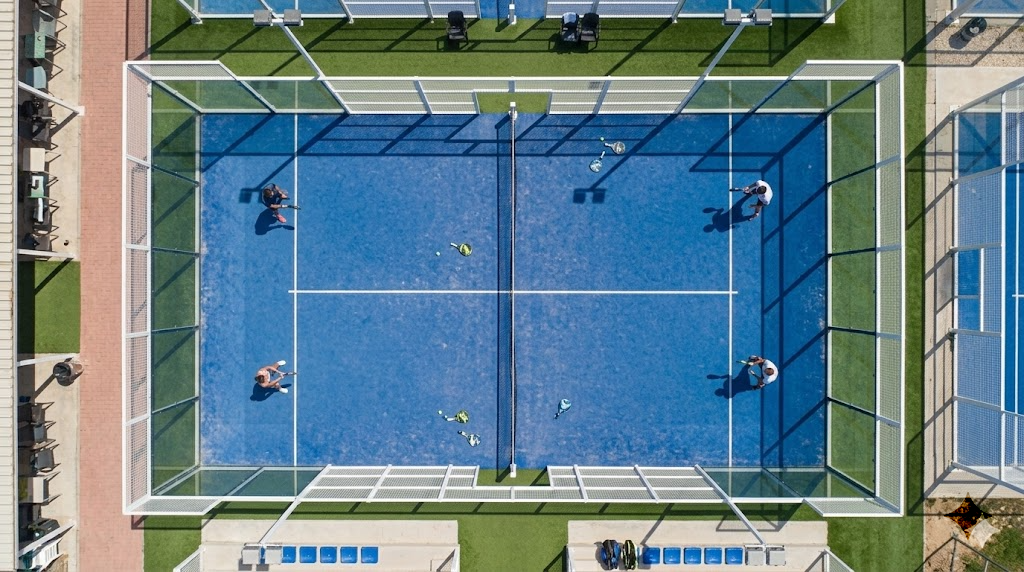
Padel is a racket sport played in doubles on an enclosed court. The court is surrounded by glass walls and fencing, and the ball can bounce off those walls during play. It uses solid rackets with no strings, and the scoring system is identical to tennis. That’s the short version. Now let’s get into the rules.
The Court and Scoring
The good news about scoring is that if you’ve ever watched a tennis match, you already know how it works. Games go 15, 30, 40, game. If both players reach 40, that’s deuce, and you need to win two consecutive points to take the game. Sets are first to six games, and you usually play best of three sets. Tiebreaks work just like tennis too.
The court is divided in half by a net, and each half is split into two service boxes by a centre line. The dimensions are smaller than a tennis court, roughly 65 by 32 feet, and the glass walls at each end and the fencing on the sides are all part of the playing area. Getting comfortable with the layout takes a session or two, but it clicks pretty quickly once you’re moving around in there.
The Serve
The serve in padel is very different from tennis and it’s one of the first things beginners need to get right.
You must serve underarm. There is no overhead serve in padel. To serve, you let the ball bounce once on the ground, then hit it at or below hip height. The ball is served diagonally, just like in tennis, into the opposite service box. So if you’re serving from the right side, the ball must land in the diagonally opposite box on your opponent’s side.
You get two attempts at the serve, again just like tennis. If your first serve lands out or hits the net, you have a second chance. Two faults in a row means the point goes to your opponents.
One thing that catches beginners out: after you hit the serve, the ball can hit the back wall or side wall on the receiver’s side and it’s still in play. The receiver just has to return it before it bounces twice on the ground. The walls don’t make the serve a fault. Only landing outside the service box or failing to clear the net does.
There’s also a foot fault rule worth knowing. When you serve, at least one foot must stay on the ground and you can’t step into the court or cross the centre line before you make contact with the ball. It’s a rule that rarely gets called in casual play, but it’s good to know.
Walls: The Part That Makes Padel Unique
This is where padel gets interesting and where most beginners feel confused at first. Stick with it because once it clicks, the wall rules actually start to feel fun.
After the ball bounces once on the ground on your side, it can hit any wall and still be in play. Your opponent can then play it off the wall. This is completely legal and in fact a core part of the game. Experienced players deliberately use the back wall to retrieve balls that would be winners in tennis, turning defence into attack.
The key rule to remember is this: the ball must bounce on the ground before it hits a wall on your side. It cannot hit a wall before it bounces on the ground without first passing over the net. If the ball comes over the net and hits the side fence directly, without bouncing on the ground first, that is out.
It’s also out if the ball bounces on the ground and then goes over the top of the wall or out through any opening in the fencing. The ball has to stay within the court boundaries after the bounce, and if it exits the enclosure, the point is over.
There is one special situation called “going around the post.” If the ball bounces in court and then exits through the side gate area or around the post at the net, a player is actually allowed to go outside the court and play the ball back in. It’s a rare situation in beginner play, but it’s legal and can produce some genuinely spectacular moments when it happens.
Lets and Faults
A let is when the serve clips the top of the net and still lands in the correct service box. Just like in tennis, a let means the serve is replayed. It doesn’t count as a fault.
A fault happens when the serve doesn’t land in the correct service box, hits the net without going over, or the server makes a foot fault. As mentioned, two consecutive faults give the point to the receiving team.
During a rally, if the ball hits the net and doesn’t make it over, the point goes to the team that hit the net. There are no lets during a rally.
When Is the Ball Out?
The ball is out when it bounces twice on the ground before a player can return it. It’s also out if it bounces on the ground and then exits the court enclosure through the top or through an opening, as mentioned above. And it’s out if a player or their racket touches the net during a point.
One rule that surprises some beginners: the ball is out if it hits the wire fencing on your opponent’s side directly off your shot, before bouncing on the ground. The ball has to land in the court before it can interact with the walls or fencing. Hitting the fence directly is a fault.
Doubles Rules
Padel is always played in doubles. There is no singles version. Each point is played four against four, two players on each side of the net.
Serving alternates between the two teams each game, and within each team, players take turns serving. So in a given game, one player serves the whole game, and then the serve switches to the opposing team for the next game. Within your team, you and your partner alternate who serves each time your team is up.
Positioning is worth understanding early. At the start of each point, both players on the serving team typically start near the baseline. After a good serve, the serving team often moves forward toward the net together. The net is where most points in padel are won, so learning to move up as a pair is one of the most important tactical habits to develop.
There are no strict rules about where players must stand during a rally, only during the serve itself. Once the point is in play, you and your partner can move freely around your half of the court.
[PHOTO PLACEHOLDER: four players on a padel court during a point, two at the net]
Common Mistakes Beginners Make
The most common one is trying to smash the ball hard like a tennis serve. The underarm serve feels unnatural at first, especially if you have a tennis background, but it’s a rule and there’s no way around it.
Another very common mistake is not tracking where the ball is going after it bounces. Beginners often assume the point is over when the ball goes toward the back wall, then get caught off guard when it comes flying back. Always watch the ball all the way through.
Beginners also tend to crowd the back wall. You need space behind you to swing, and standing too close to the glass limits your options considerably. Try to give yourself at least a metre of clearance when you’re at the back of the court.
Finally, beginners often forget that padel is always doubles and try to cover the whole court alone. Trust your partner and communicate. The sport rewards pairs who move together, cover each other, and talk during the point.
Quick Reference: The Rules That Matter Most
The serve is underarm, below hip height, and diagonal. You get two attempts. The ball must bounce once before you hit it.
After the serve, the ball can bounce off walls after it hits the ground. It cannot hit the fence before bouncing. If it exits the court after bouncing, the point is over.
Scoring is identical to tennis: 15, 30, 40, game, set, match.
The game is always doubles. Four players, two per side.
A let on the serve means replay. Two faults in a row lose the point.
Just Get Out There
Padel is one of those sports where the rules make a lot more sense once you’re actually playing. Reading about wall bounces and underarm serves is helpful, but feeling it in real time is where it truly clicks. You’ll make mistakes in your first few sessions. Everyone does. The important thing is to keep moving, keep communicating with your partner, and enjoy the game.
If you want to understand how padel compares to tennis in more depth, including more on the court, the racket, and why the two sports feel so different, check out our guide to Padel vs Tennis: What’s the Difference?
See you on court.